- Dividends & Downtime
- Posts
- Building Habits and Getting Organized
Building Habits and Getting Organized
It's still January... it's not too late!

Xander Melrose
January 22, 2024
Happy Monday!
Read Time: 7 Minutes
In our relentless quest to balance work, studies, and personal life, a tool that syncs everything in one place is nothing short of a blessing. Enter Notion's latest feature, the "Notion Calendar." My big thing this year is being efficient and meaningful with my time - and NotionHQ made time management even more effortless.
In this week’s rundown:
Finance Update: What’s new with Generative AI?
Notion Calendar: I LOVE YOU IVAN ZHAO
Habit Building: Make yourself a bit better every day.
Real Estate Run-Down: Build your own shack! (Legally)
Social Ledger: Portsidddeeeeee (& Beyond Finance)
Did I do it?
Career Compass
Market Changes

Good Morning D&D Readers,
We’re 21 days into January, how are those resolutions coming?
Generative AI: Usually I start with some definitions, but at this point, if you don’t know what AI is by now … you should check out an earlier edition of dividends and downtime :) Generative AI is AI that can create new content independent from a human user. Breakthroughs in generative AI technology could mean major developments in the content creation field and revolutionize the way we view media. Imagine your friend that can’t take pictures to get their thumb in the corner of the frame, and you could just ask Siri to remove it. Some major players are investing in the generative AI space, such as McKinsey x SAP, Google, and even Apple(allegedly).
ElevenLabs: An AI-Voice Cloning startup company called ElevenLabs just secured an $80 Million Series B round of funding making its valuation $1.1 Billion. ElevenLabs was founded by former Google and Palantir and boasts a mastery of AI voice cloning capable of realistically simulating human voices in various languages. They plan to use the funding to expand the range of languages, create new features such as full length AI movie dubbing, and improve the interface of the program.
WHO AI Guidelines: The World Health Organization has recently released its guidelines on the ethics and governance of large multi-modal models (LMMs) , a type of generative AI. These LMMs have the capability to accept more than one type of input, so it’s basically able to interpret a combination of things such as text, images, videos, etc. Anyway, the WHO released guidelines on how these systems should be used that basically require heavy transparency and security if they are to be used in healthcare. These systems could revolutionize diagnosing diseases remotely, analyzing data for medical research, and speeding up medical processes. To learn more in depth about potential benefits and risks, check out the WHO site linked above.

In Finance,
S&P 500 up around 2% this week
NASDAQ 100 up around 3%
Dow Jones up around 1%
Bills fans down 7000%
What Happens if Trump Wins: If Trump one the first task on the to-do list might be an implementation of a 10% Tariff on US Industry in order to profit more from trade. Specifically on China, lawmakers recommend an increase on tariffs on Chinese imports and restrict investment in that country to try to reduce our reliance on the Chinese economy. In addition, the tax cuts that the Trump Cabinet put into motion during his presidency would be made permanent instead of expiring in 2025. Of course other predictable changes such as tightening immigration, relaxing on government spending, pull out of the paris climate accord, among others.
Natural Gas: Natural gas prices continue the year's downward slope dropping 6% this week. Due to warm fall and winter weather, heating buildings has become cheaper, decreasing the demand for natural gas.
CA is $$$: TD reveals the result of a survey conducted across Canada detailing how Inflation and cost of living are the biggest financial challenges Canadians will be facing. Nearly 70% are worried they wont be able to afford any unexpected costs worth $1,000 or more and 53% are worried they won’t have enough money to pay for food for their family. The raising interests are a major concern that Canadians are starting to voice after the massive interest rate hikes over the past year. Fiscal policy in Canada will definitely be a vital topic to keep track of in 2024 policy updates.
Academic Alley
If you have met me, you know how much I love Notion. One of the only inconveniences I had ever experienced was the integration of Google Calendar, as I found the embedding wasn’t always bug-free and occasionally gave me a bit of a hard time. On Wednesday, January 17, I received one of the best birthday presents ever. NotionHQ has officially released its “Notion Calendar,” seamlessly integrating your Google Calendar with Notion.
Understanding Notion Calendar
What It Is:
Notion Calendar is a new feature that bridges your Google Calendar with Notion, creating a synchronized, comprehensive view of all your commitments. Whether it's project deadlines or dinner plans, everything finds a place in this integrated system.
Why It Matters:
For students juggling multiple commitments, this integration means a more organized, less chaotic way of managing time. You can have your class schedules, assignment deadlines, work shifts, and social engagements all visible in one unified calendar. If Notion had simplified your life before, they’ve just stepped up their game even more.
Setting Up Notion Calendar
Connect Google Calendar:
Start by linking your Google Calendar with Notion. It's a straightforward process where you just follow the on-screen instructions after selecting 'Add to Notion' on the Google Calendar integration page.
Customization:
Once synced, you can customize the view. Choose how you want your calendar to appear – daily, weekly, or monthly. Just like Google and Apple, you can colour-code different types of events for a more precise visual distinction.
Managing Tasks and Events:
Add tasks directly in Notion, and they'll reflect in your Google Calendar. This works both ways - events from Google Calendar will appear in Notion as well.
Notifications and Reminders:
Set up reminders and notifications within Notion to keep you on track.
Benefits for Students
All-in-One Dashboard:
With Notion Calendar, your academic and personal schedules coexist in harmony. It's your one-stop dashboard for all time-related matters.
Efficient Task Management:
Tracking assignments, exams, and project deadlines become more manageable. Less time wondering "what's next?" and more time doing.
Visual Organization:
The visual aspect of colour-coding and clear layouts aids in better understanding your schedule at a glance – crucial for busy students.
Sync and Share:
Share your Notion Calendar with peers or study groups. Collaboration on group projects or study sessions becomes much more efficient.
I’ve only had access to this calendar for a few days, so I can’t really give it a fair review. However, the interface (on Mac) is very user friendly, and I’ve converted my entire schedule over very easily. I am very excited about this new feature, and am looking forward to what’s to come.
Building Habits
Introduction
Habit building is not just about creating a routine; it's about shaping your identity and future. Understanding the science behind habits can empower us to create lasting changes in our lives. Based on insights from Dr. Andrew Huberman and other experts, let's enhance our initial discussion on habits with more nuanced strategies and scientific explanations.
Habits - What should I know?
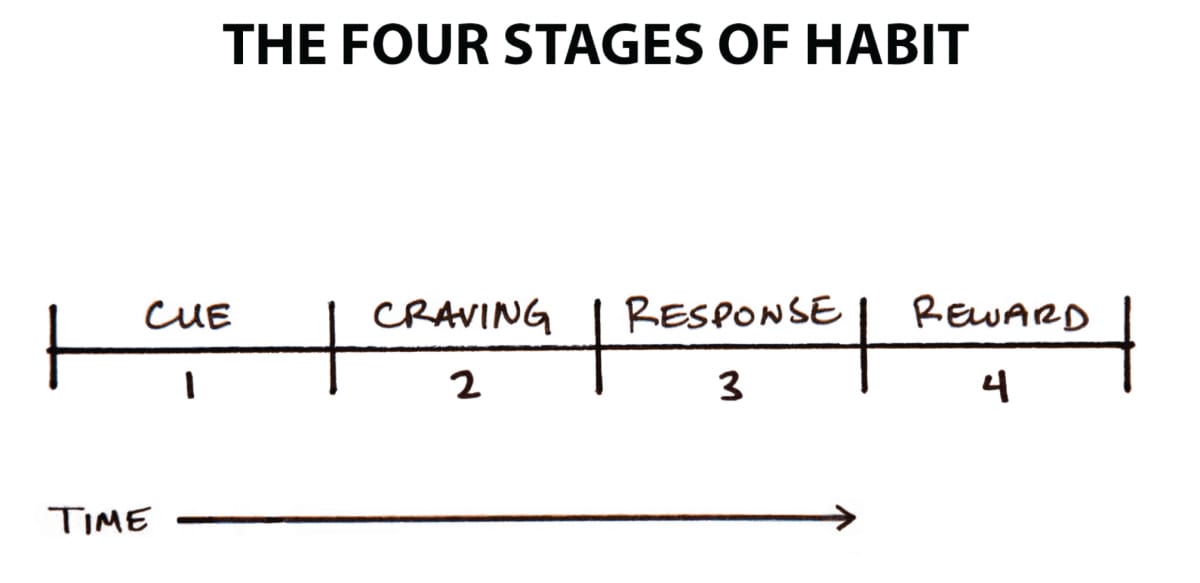
As previewed in last week’s article, there are four stages to a habit. However, there’s a lot more to a habit than just 4 sections. Let’s do a quick breakdown on everything you need to know.
Goal-Based vs. Identity-Based Habits:
Immediate goal-based habits are focused on achieving a specific outcome each time they're performed. Identity-based habits, however, are linked to a larger vision of oneself. This distinction affects how dopamine, the motivation-regulating chemical, influences habit persistence.
Routine v/s Habits - Nir Eyal :
A habit is a behaviour done with little thought or subconsciously, such as checking your phone. A routine on the other hand is an intentional series of behaviours. To become a habit, a behaviour must become an intentionally repeated routine. This is where most people fail in habit formation. They attempt to skip the routine phase - where we actively have to perform the behaviour we would like to be a habit, and nothing changes.
Time of Formation:
There’s no set time for a habit to form. Studies show it can take anywhere from 18 to 254 days to build a new habit. A key factor is 'limbic friction' as coined by Andrew Huberman, which is the effort needed to engage in a particular behaviour. The less limbic friction, the more likely a habit will form.
Building Habits - 21 Day System
Dr. Andrew Huberman - the Stanford professor and the love of my life, suggests performing Six new habits across 21 days. Now, Huberman did not invent the 21-day rule (Dr. Maxwell Maltz popularized it in the 1960s), but he puts an interesting spin on it and suggests ways to make the most of the method. As we’ve discussed before, forming a habit can take shorter or much longer than 21 days, but for today’s article, we will work off of this theory.
21 Day System:
Choose six habits you would like to perform and write them down.
You do NOT have to do all 6 of them daily - just try to get 4 or 5. (If you do even less - start over! We’re still young; you’ve got time to try again.)
If you only do 4 one day, do not do extra the next to make up for it (we’re trying to build consistency - you want to build routines you can keep)
On the 21st day, don’t just swap out your six habits for six new ones - assess how well the building process went. A habit is defined as a behaviour performed about 85% of the time with little/no effort.
Breaking Bad Habits
Replacing, Not Just Removing:
It's more effective to replace a bad habit with a good one than to try to stop the bad habit simply. This helps to dismantle the neural circuits associated with the bad habit.
Simple Replacement Behaviours:
Choose easy, positive behaviours to replace bad habits. This creates a cognitive and temporal mismatch between the trigger and the response, easing the breaking of the bad habit.
Habit building is a complex, pain-in-the-butt process that is no fun. There are many more aspects to the process of building a habit, but this is a perfect intro for those looking forward to finally getting around to some of their New Year resolutions. If you want to hear more, feel free to reach out or read up on the sources below.
Sources:
Habits v/s Routines - Nir Eyal
STUDENT LIFE
Real Estate Run-Down

Pipes bursting left and right due to the freezing temperatures caused by the Polar Vortex. Last year we saw a few homes in Texas boil over in the heat, and then flood during the freeze. With climate change on the rise, B.C. needs to update it's Building Codes.B.C. Building Codes ensures the safe construction of all new homes. Currently, legislators are focused on sustainable home design, specifically on efficient energy usage. But how do you build a home? I'll give you a general run down so your Vancouver shack lasts you longer than a few weeks.
Building Design and Construction
Let's say you (legally) acquire a plot of land, and want to build a house on it. First, you must obtain all the required permits, such as an "Owner-Builder Authorization".
If you intend to:
Live in the home you are building
Are an individual (not a corporation)
Manage all the construction
Thennnn…. you are eligible for this authorization! (Which exempts you from many of the licensing and warranty insurance requirements) Now let's say you'’ve got all the licenses and wish to begin construction. The B.C. Code has a few main foci;
Structural strength to resist forces acting on buildings
Resistance to the spread of fire
Resistance to heat movement and vapour transmission
Adequate means of egress (ability to vacate)
Adequate light and ventilation
Resistance to sound transmission
Protection against smoke penetration
Now, building a home is no simple task, thus many hire builders and contractors to avoid any legal issues that may arise during or after the process. I doubt any of us will be building homes in our lifetimes, but make sure to follow the correct guidelines when constructing your shack!
Joey’s Pick of The Week

228 3563 ROSS DRIVE, Vancouver, BC
2 Bed
2 Bath
877 sqft
$3650
Here's something on the higher end of rental properties. Situated in the lavish Wesbrook Village, you're about a 5-minute bus from campus. This two-bed 2, two-bath apartment comes at an individual monthly rent of $1825, delivering you 9-foot ceilings and "engineered oak floors". Personally, I'm way out of my budget, but if you're looking to live in luxury right next to UBC, this is the apartment for you!
Social Ledger: Get Sipping

I visited Portside for the first time last week, and I can happily say I have hopped on the bandwagon. I was and am still not a fan of the fact that you have to arrive before 9:30 if you do not want to wait in line for two hours, but that slight inconvenience is worth the atmosphere and fantastic music they had going on.
TLDR;
Who? → The Portside Pub
What? → Partayyyy
When? → Friday, Jan 26 (BEFORE 9:30!!)
Where? → The Portside Pub
Why? → I love portside portside is so awesome god i love portside
How? (much) → $12 Cover
Social Ledger: Not-Sipping
If you are interested in Finance and are wondering what working outside Vancouver is like, the Beyond Vancouver: Finance Panel is for you. This event intends to speak on real-world experience working outside of Vancouver, brought to you by UBC Alumni. The speakers have experience working in London, New York, Toronto, Montreal, Sydney and San Francisco. In addition to city experience, it’s the perfect option for aspiring finance bros, as they’ve got experience as Investment Banking Analysts, Capital Transactions Managers, Finance & Business Operations, Investment Analysts, and Private Equity. The setup for the night is a thirty-minute general Q&A, followed by individual break-out rooms where the Alumni will rotate through to provide a more personalized experience.
TLDR;
Who? → Sauder Alumni
What? → Career Advice
Where? → Zoom
When? → January 23, 12:00 PM
Why? → J.P Morgan is not going to reach out to you…
How? (much) → Free! Register on COOL.
WRAPPING UP
We are done!!!
As usual, we are so glad to have you all here. We are constantly on the lookout to improve, so feel free to email us below.
Now… one more important question before you all leave us for the week.
Did I do it?